
You can read just a bazillion online reviews about how great this camera is. How photographers beat off muggers by hitting them with their F2s or how the camera survived after tumbling down a mountain. There are places where you can read in finite detail about the various finders that turn an F2 into an F2SB, F2S, F2A or F2AS.
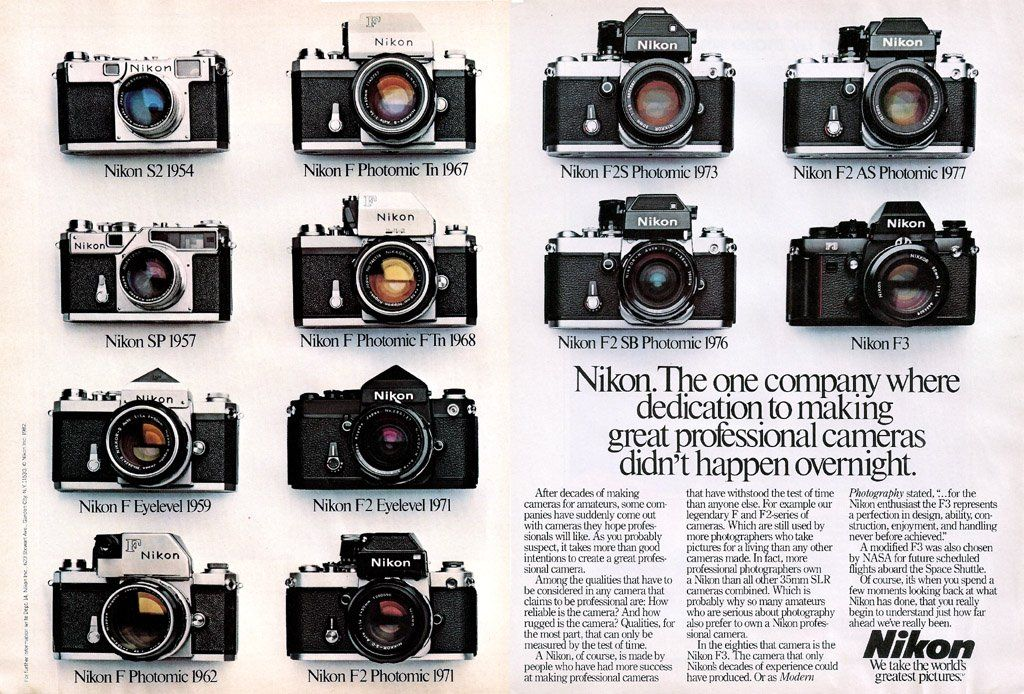
When the Nikon F was first introduced in 1959, it was recognized as the most advanced single lens reflex (SLR) camera to date. In terms of popularity, however, it trailed later models by a wide margin. This may have been attributable to a high retail price when compared with other SLRs. As time passed, though, more people experienced firsthand the camera's high level of performance and the accolades began rolling in. The Nikon F became a "legend".
The dramatic rise in popularity can be traced primarily to two of the camera's characteristics — high reliability and multiple functions. No comparable camera even came close to the rugged body, extensive lineup of interchangeable lenses and wide variety of accessories that the Nikon F had to offer. By 1959, we'd entered a new era for 35mm (135) format SLR cameras. Revolutionary mechanisms and technologies came one after another. The old-fashioned mechanism of the Nikon F stood out in this time of significant advancement.
After nine years on the market, only 300 thousands units of the Nikon F had been sold. This represented a grand total of one-third of the entire inventory. Given this, Nippon Kogaku K.K. could not possibly have forecast what was to come. The Nikkormat (Nikomart), with the catch phrase "TTL metering + Nikkor lens", had become the successor to the FTN model and had achieved a high degree of popularity. The success of the Nikkormat paved the way for the Nikon F.
This model was originally referred to as "F’" during its course of development, but it was later renamed to "A". The "A" model was supposed to represent the correction of every problem with the Nikon F. Incorporating the popular Nikon motor drive system, along with TTL metering, the "A" was also designed to offer an overall increase in quality. The body of the "A" contained many unique ideas — the shutter's charging mechanism, the release mechanism, the construction of the driving spring cylinder, and more. These new features were not at all influenced by the old Leica. Through the use of titanium (Ti) in the reflex mirror frame, the mirror — which caused virtually no finder vignetting — could be driven faster than with the Nikon F. The engineers were determined to make the "A" the ideal camera in terms of mechanics.
The combination of the Motor drive F36 and the direct-connecting battery case truly represented the dawning of the motor drive era in photography. The motor drive gained worldwide popularity due to its mobility. Later, the noise it created would become a problem ; nonetheless, the motor drive was established as a symbol of high class among more experienced users. It would be designed exclusively for the "A" model. Among its new features were quicker film advance (five(5) frames / sec., up from four(4)), electronic film rewind and auto frame counter reset.
The biggest similarity between the Nikon F and the F2 was most likely the finder composition. The Nikon F's interchangeable finder enabled it to incorporate TTL metering later. With the Photomic TN finder, the metering became center-weighted. And, just as the Nikkormat (Nikomart), it functioned as an exposure meter, and was very well received. It did not employ body metering, but rather a system of metering using interchangeable finders. Other minor improvements were also being made, such as a new method of attaching the finder, employing a film advance switch to ensure that the exposure meter isn't left on inadvertently, and the addition of an eyepiece with a built-in ready light.
The development of the "A" overlapped the development of a camera for NASA's Apollo and Skylab. As such, in the "A" — particularly in its motor drive — we can see some features adopted from the camera designed for NASA. In addition to technological improvements, design and operational aspects of the "A" were upgraded. NASA's camera had a film advance lever large enough to be operated by an astronaut wearing gloves. This was the inspiration for the wide finger area on the "A" model's film advance lever. Furthermore, the body of the "A" was curved to better fit in the hands of the user — in contrast to the sharp lines of the Nikon F2
The release and the sales of the Nikon F2 on September 21, 1971, drew a great deal of attention. The most popular aspects of the new camera were its completely new control system and the enhanced motor drive. Later, the Photomic S finder and the EE control unit were developed. These features enabled metering and auto exposure in low-light situations, greatly enhancing the F2's overall functionality. From a more critical standpoint, the F2 seemed to represent a very conservative change. It appeared to be nothing more than a "curved F".
During the development of the F2, Nippon Kogaku K. K. 's motto was "quicker and stronger". This seemed to symbolize the 1970s, as everything from society to technology was growing at a staggering pace. The production of the F2 in the following month exceeded that of the Nikon F during the same relative period, and the F2 is still in use worldwide. Unfortunately, the F2 lost some of its appeal once the photography world learned of the electronic shutter.
Mechanical cameras today are not relegated to display duty or looked at merely as collector's items — they are still put to good use by photographers worldwide. As mechanical cameras go, the F2 is regarded as the most efficient and powerful SLR camera. Perhaps the most accurate evaluation of this huge project from the past is a recounting of its own history.